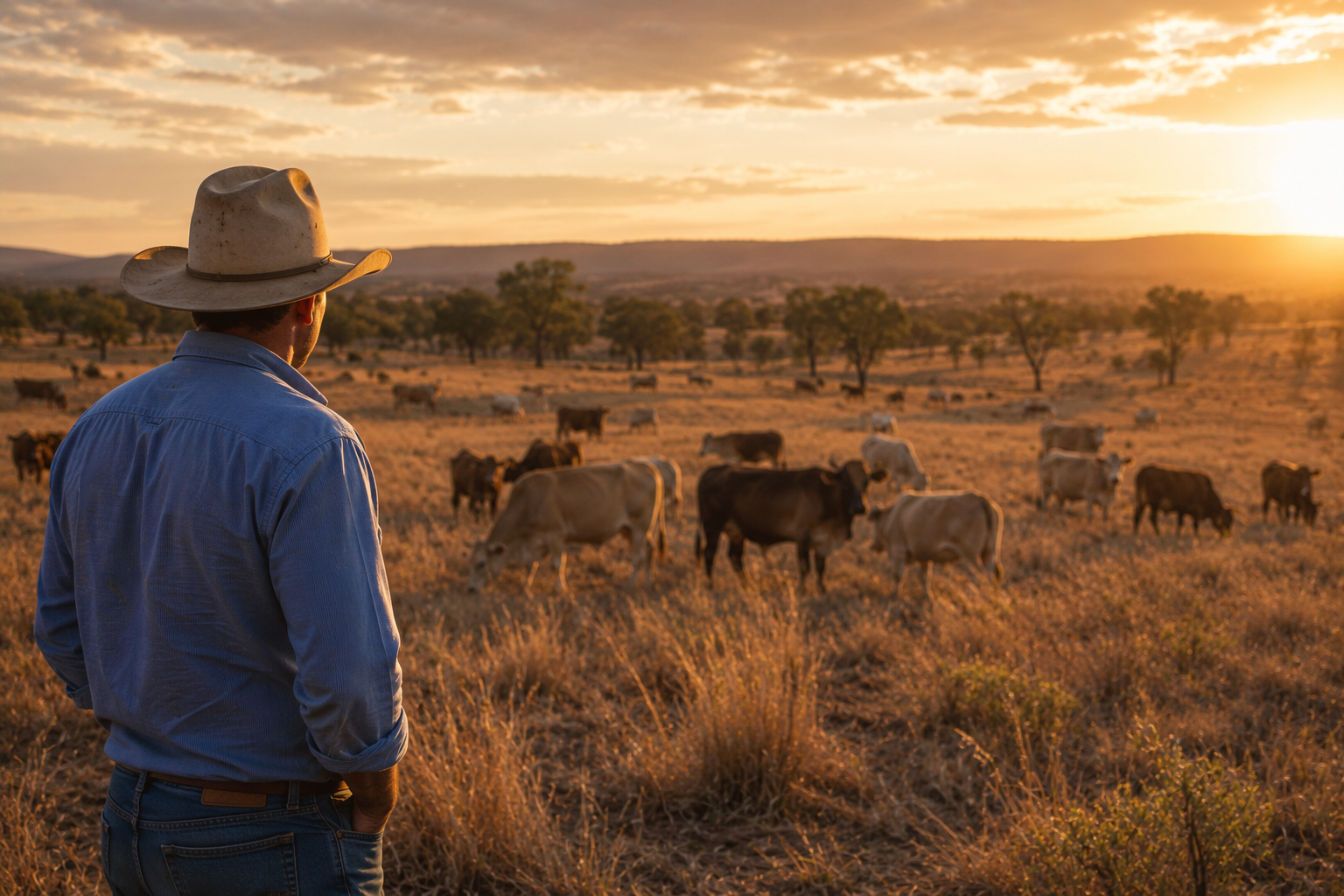
Every Australian producer knows that no two seasons are the same. When an El Niño weather pattern develops, many grazing regions experience hotter temperatures, reduced rainfall and longer dry periods. While every property responds differently, these conditions often place additional pressure on pasture production and livestock performance.
Managing nutrition becomes one of the most effective ways to maintain productivity during these challenging seasons.
The biggest challenge isn’t El Niño itself – it’s waiting too long to respond.
Rather than waiting until stock begin to lose condition, proactive supplementation can help support animal health, maintain growth rates and improve reproductive performance when pasture quality begins to decline.
What does El Niño mean for pasture quality?
Dry conditions don’t just reduce the quantity of feed available. They also affect its nutritional value.
As pasture matures or dries off, livestock often consume forage that contains:
- Lower crude protein
- Reduced digestible energy
- Less phosphorus and sulphur
- Fewer essential trace minerals
- Higher fibre, making feed harder to digest
During prolonged dry conditions, pasture crude protein can fall below the 7–8% threshold required to support efficient rumen microbial activity. Without adequate nitrogen and sulphur, rumen microbes become less effective at digesting fibre, reducing the amount of energy cattle can extract from forage. As a result, paddocks that appear to have plenty of feed may no longer provide the nutrients needed to maintain optimum production. ¹, ², ³
The result can be:
- Reduced weight gain
- Lower fertility and conception rates
- Poorer weaner performance
- Lower feed conversion efficiency
- Increased nutritional stress
By the time weight gains slow or cattle begin losing condition, the opportunity to make small, cost-effective adjustments has often passed.
Supplementation shouldn’t be static
Many supplementation programs are designed at the beginning of the season and remain unchanged for months.
The reality is that livestock nutritional requirements change as seasonal conditions change.
A formulation that performs well early in the season may no longer be the best option several weeks later as pasture quality declines.
The real question is: “Is my current supplementation strategy still matching today’s conditions?”
Small decisions make the biggest difference
Successful producers don’t simply react to drought – they continuously adapt.
Monitoring pasture quality, intake, understanding how cattle are responding, and adjusting supplementation before performance declines can help minimise production losses and make better use of feed resources. ⁴
Access to real-time intake data and on-farm insights allows producers to make informed decisions based on what’s happening in the paddock – not what they assume is happening.
The earlier changes are identified, the more options producers have.
Why consistency becomes more important during dry conditions
Every producer understands the value of supplementation during challenging seasons.
The more difficult question is whether every animal is receiving the intended amount.
Traditional supplementation methods remain an important part of Australian grazing systems, but intake naturally varies between animals. Factors such as herd hierarchy, paddock size, distance to water, weather and individual behaviour all influence how much supplement is consumed.
During prolonged dry conditions, when pasture quality is already limiting performance, consistency of nutrient intake becomes increasingly important.
Variation in intake of free-choice supplements between animals is well recognised and may reduce the effectiveness of supplementation programs. Improving intake consistency can help achieve a more uniform nutritional response across the herd. ⁴
Where precision water supplementation fits
Water is one of the few resources livestock access consistently throughout the year.
For that reason, it provides a practical pathway for delivering nutrients with greater consistency across a mob, while allowing producers to adjust formulations as seasonal conditions evolve.
At DIT AgTech, our approach is built around that principle.
Rather than viewing supplementation as a fixed seasonal program, we work with producers to match nutrient delivery to changing pasture conditions and production objectives.
Through the uDOSE™ platform, producers can deliver targeted supplements including phosphorus, trace minerals, protein-based formulations and production-specific supplements, while using DIT Lab‘s water, pasture and dung analysis services to better understand what their livestock are actually consuming.
The objective isn’t simply to supplement more. It’s to supplement with purpose.
Preparing for the season ahead
El Niño will come and go.
Seasonal conditions will always be unpredictable.
The producers who consistently achieve better outcomes aren’t necessarily those with the best seasons – they’re the ones who adapt the fastest.
At DIT AgTech, we believe precision livestock management is about giving producers the information they need to make timely, confident decisions. Because in challenging seasons, success isn’t determined by the weather – it’s determined by how quickly you respond to it.
Sources:
¹ National Academies of Sciences, Engineering, and Medicine. (2016). Nutrient Requirements of Beef Cattle (8th Revised Edition).
² Minson, D. J. (1990). Forage in Ruminant Nutrition.
³ Meat & Livestock Australia (MLA). Phosphorus supplementation in northern Australian beef herds.
⁴ Bowman, J. G. P., & Sowell, B. F. (1997). Delivery method and supplement intake variation in grazing ruminants. Journal of Animal Science.